How Much Does Custom Software Cost? An Honest Price Guide
"What does it cost?" is the first question in almost every initial consultation — and very few agencies answer it publicly. We do. Not to the euro (that would be dishonest), but with realistic ranges you can use for orientation.
The short answer: typical price ranges in 2026
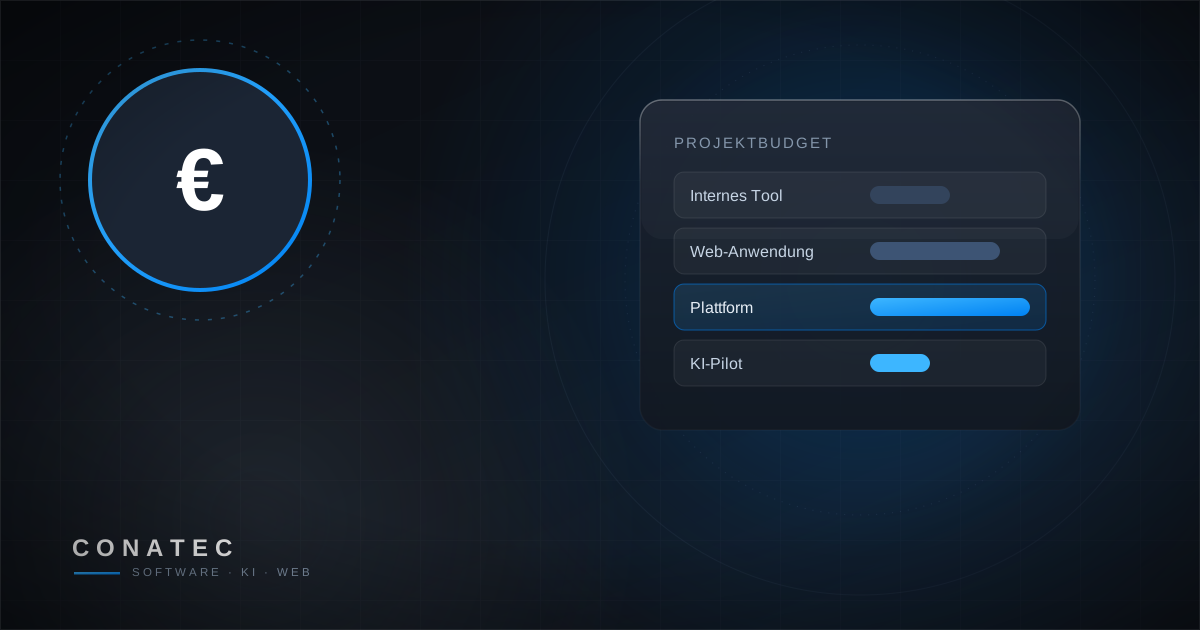
- Small business application / internal tool: approx. €8,000–25,000 — e.g. equipment management, an approval workflow, a reporting tool.
- Web application with multiple roles and integrations: approx. €25,000–80,000 — e.g. a customer portal or an inventory system.
- Complex platform / digital product: from €80,000 — multiple systems, high load requirements, long-term development.
- Automation / AI pilot: approx. €5,000–20,000 — one clearly scoped process, e.g. automated document processing.
Important: these are project prices for the first production version. Software lives — plan for roughly 15–20% of the build cost per year for maintenance, updates and smaller extensions.
What really drives the price
1. Number of roles and permissions
An application used only by your team is significantly cheaper than one with customer access, an admin area and fine-grained permissions. Every role means its own views, its own tests, its own edge cases.
2. Integrations with existing systems
Connecting to ERP, accounting or Microsoft 365 is often the underestimated cost block. A clean interface to a well-documented system is built quickly — connecting to a 15-year-old niche system without an API can cost more than half the application itself.
3. Data migration
Should existing data be migrated? From Excel, that's usually quick. From a legacy system with grown data inconsistencies it becomes its own sub-project — one that's almost always worth it, because clean data is half the value of the new software.
4. Design ambition
An internal tool needs a tidy, functional interface — not award-winning design. A customer portal representing your brand is a different story. Be honest about what it should be, and don't pay for polish nobody sees.
Fixed price or time & materials?
Both have their place. A fixed price works well when the scope can be clearly defined — you carry no budget risk, we calculate a buffer. We work on a time & materials basis when requirements sharpen during the project — for genuine innovation projects that's more honest than a fixed price that gets renegotiated through change requests. We often combine both: fixed price for the clearly scoped first stage, then time & materials with a monthly budget cap.
How to spot questionable offers
- A price without questions: anyone quoting you after five minutes hasn't understood your problem.
- No statement on running costs: hosting, maintenance and updates don't disappear — they're just not in the quote.
- "We do it all with AI, so it costs almost nothing": AI genuinely accelerates development — but requirements analysis, testing, integration and responsibility remain human work.
- Unclear code ownership: after payment, the source code is yours. Full stop. Anything else is a lock-in trap.
How to get a reliable number
In a free initial consultation we clarify goal, user base, integrations and data situation — then you receive a written assessment with a price range and a recommendation for the most sensible first step. Often that's a smaller start than expected: a focused first version that delivers real value quickly beats the five-year plan almost every time.